Is this article for you? Running a container depot (gate moves, yard management, repair estimates)? → Keep reading. Running a port terminal, warehouse, or transport company? → This is not your list.
Table of Contents
- What is container yard management software for container depots?
- How we selected these tools — and what we excluded
- Top 6 best yard management software tools in 2026
- Quick comparison table
- How to choose the best container yard management software for your depot
- Yard management software vs terminal operating system (TOS)
- FAQ
- Final verdict
1-What is yard management software for container depots?
Quick answer:
The best yard management software for container depots in 2026 includes Shipzzer, ContPark, Containerchain, iDepo, Kaleris, and LogStar.
Ultimately, the right choice depends on depot size, and furthermore, whether the system supports tablet-based container inspections, native repair estimates and EDI workflows, and direct connection to shipping lines — all without requiring enterprise infrastructure.
Yard management software (YMS) for container depots is an operational system that manages and tracks container movements in the depot yard in real time — covering gate moves, damage surveys, repair estimates, yard inventory, and reporting. The tools in this list focus on inland container depot workflows, not generic warehouse systems or large port terminal operating systems.
Without one, the numbers are painful. Manual check-in processes take 10 minutes or more per truck. A survey from Supply Chain 24/7 found that 41% of logistics managers cite manual processes as their top operational pain point. Spread that across a busy depot day and you are looking at hours lost, EDI validations delayed, unnecessary crane moves, and containers going untracked.
Many depots still operate with clipboards and manual logs. Indeed, while these repetitive routines feel “mastered,” they create a dangerous illusion of control. In reality, however, this model cannot scale.
The Limits of Manual Management:
- The Scalability Trap: You cannot handle higher volumes or demanding new clients with tools that don’t talk to each other.
- Operational Blindness: Repeating manual gestures feels reassuring, but it lacks the real-time data needed to optimize a yard.
- The Workflow Gap: Modern logistics require complex, automated workflows. Meeting these demands with a pen is no longer just difficult—it is impossible.
True mastery isn’t about repeating old habits; it’s about digital agility. A YMS turns your depot from a manual site into a scalable powerhouse.
Growth begins where the paper ends.
A complete yard management software solution for container depots covers gate in/out, container inspections, automated EMR quotes, real-time yard inventory, and client portals — from a single operational system used by your yard team directly on tablet.
To understand the fundamentals first, read our guide on what a yard management system actually does.
2-How we selected these tools — and what we excluded
We evaluated software that covers container depot workflows effectively — and, regardless of whether a platform also serves terminals, yards, or broader logistics operations, we focused on depot-specific fit.
What mattered was how well each tool handles the core depot workflow: gate moves, container inspections, EMR repair estimates, EDI to shipping lines, yard inventory, and billing.
Ranking logic:
We prioritised depth of depot-specific workflows above all else. Consequently, tools with weaker coverage of container surveys, repair estimates, or gate moves were ranked lower, regardless of overall feature count or platform breadth.
Each tool was evaluated on 10 criterias :
- Gate in / Gate out — built for depot workflows or adapted from something else?
- True Multimodal Integration — does the system treat road, rail, and barge flows with equal depth? After all, a top-tier YMS must handle complex intermodal handovers, ensuring that container data remains consistent whether it arrives on a chassis, a rail wagon, or a river barge.
- Next-Gen Innovation (Native OCR & VBS) : Is the tech built-in or bolted-on? We look for native Optical Character Recognition (OCR) for instant container identification and integrated Vehicle Booking Systems (VBS) to eliminate gate congestion. True innovation means reducing manual entry to zero
- Yard Management (stacking rules, yard live view, inventory live view)
- EMR and M&R repair workflow — native estimates, client approval, and audit trail?
- Container inspection and damage tracking — real survey process support?
- EDI integration — connects to the major shipping lines your depot works with?
- Depot size fit — realistic for small and medium operations, or enterprise-only?
- Tablet and mobile access — field use without heavy hardware?
- Intuitive UX/UI (Desktop & Mobile) : On Desktop: Office staff get a powerful, “at-a-glance” dashboard to manage billing and planning without digging through endless menus. On Mobile: The app is designed for “one-handed” operation in the field. Large touch targets, high-contrast displays for outdoor visibility, and a logical flow mean your team spends less time looking at screens and more time moving containers.
What we excluded:
Port terminal operating systems (Navis, Tideworks), generic warehouse tools, and freight platforms with no meaningful role in container depot operations.
Editorial note: Feature availability was checked on public product pages in April 2026. Some vendors offer modular or custom deployments — features listed reflect public documentation only. Custom deployments may differ.
3- Top 6 best yard management software tools for container depots in 2026
#1 Shipzzer — Best depot-native tool for small and medium container depots
Is this you? You manage one or more container depots. Your team works on the yard floor. You need gate moves, yard management, fast inspection, damage surveys, EMR quotes, and client approvals — without a 6-month IT project and no fixed camera hardware.
Not for you if… You run a large port terminal or a CFS operation focused primarily on bulk cargo consolidation — Shipzzer is built for the empty and loaded container depot workflow, not Terminal forklift handling or enterprise-scale supply chain execution platforms..
Shipzzer is built from the ground up for container depot yard management — not adapted from a warehouse tool or a port TOS. Every feature maps to real depot workflows: gate moves, container inspections via tablet, automated EMR repair quotes, and live dashboards visible to both your team and your clients.
The standout in 2026 is the combination of OCR container recognition from a standard tablet (container MAEU 123456 5 is read automatically at entry — no fixed cameras, no manual typing) and automated EMR quote generation. The EMR quotation feature runs the full workflow — damage detection, photo via tablet, EMR quote, EDI-compliant validation and approval — without phone calls or email chasing.
It also reduces unnecessary crane moves and improves container turn-time by keeping the yard inventory accurate in real time.
For teams managing multiple sites, Shipzzer also works as a mobile yard management app — tablet-first, deployable in a few weeks without a dedicated IT team, no heavy camera infrastructure or complex IT setup required.
It also supports multimodal depot operations, tracking container flows across road, rail, and inland waterway from a single dashboard.
Key features (verified):
- Gate in / gate out with tablet-based OCR — container number recognised at entry
- Automated EMR repair quotes sent directly to shipping lines for approval
- EDI-compliant for the world’s top 10 shipping companies (codeco, westim, coparn etc.)
- Vehicle Booking System (VBS) — truck slots pre-booked, queues eliminated
- Multi-depot live dashboard — one view across all your sites
- Real-time operations dashboard for yard, repairs, and inventory
- Spare parts manager with auto-reorder based on usage patterns
- 24/7 client portal — inventory, bookings, service history
- Multimodal support — road, rail, inland waterway tracked in one system
- Intelligent bay manager — custom stacking rules to minimise crane moves and reduce turn-time
- Integrated billing and invoicing — automated charges per container event
- Complete audit trail + unlimited historical data (5+ years)
Strengths:
The only tool on this list built tablet-first with no heavy camera infrastructure required. OCR, EMR, and EDI validation workflows in one uninterrupted flow. Deployable in a few weeks without a dedicated IT team. Intelligent stacking rules keep crane moves to a minimum and container turn-time optimised.
Honest limitation:
Shipzzer is built specifically for container depots. If you operate a mixed facility with bulk cargo, large-scale CFS, or complex port terminal operations, you may need a broader platform.
👉 Book a demo with Shipzzer — see the full tablet-to-quote workflow live.
#2 ContPark — Cloud-based depot and terminal platform with strong yard planning
Is this you? You manage a mid-to-large inland depot or ICD and need a proven cloud platform with strong gate, 2D/3D yard visualisation, and EDI capabilities.
Not for you if… You need a single integrated system with billing and OCR included out of the box — ContPark’s modular structure means several capabilities are available as separate named modules rather than in one base package.
ContPark is a cloud-based container depot and terminal management system covering gate operations, container inventory, yard planning, M&R workflows, billing, and EDI reporting. It serves inland depots, container freight stations (CFS), and intermodal hubs. The platform includes a 2D/3D yard map, mobile access across devices, and a client portal where customers can accept or refuse repair work.
Key features (verified from contpark.com):
- Gate in / Gate out with driver and truck registry
- 2D/3D interactive yard map with real-time container positioning
- M&R repair module with defect list, photos, and client approval
- EDI integration including CODECO with major shipping lines
- Contpark.Billing module — billing and invoicing (available as a named module)
- Reporting dashboard and KPI analytics
- Mobile-friendly across all devices
Strengths: Solid cloud architecture, strong yard visualisation tools, broad EDI coverage. Modular structure — you configure what you need.
Pricing: No public pricing. Custom quote model. Contpark.Billing is a named separate module — billing appears to be modular rather than included in the base CDMS, though exact inclusions vary by deployment.
Honest limitation: ContPark’s OCR (VisionAI) is a separate module within their CTMS suite, using IP cameras for real-time scanning — not a tablet-native solution. ContPark also serves terminals, railway yards, and general cargo — not exclusively container depots.
#3 Containerchain — Strong on truck flow, VBS, and EDI for busy depots
Is this you? Your depot handles high daily truck volumes and gate congestion is your biggest pain. You need a proven VBS and automated truck scheduling as the core of your operation.
Not for you if… Your primary challenge is EMR quote automation or tablet-based container inspections — Containerchain’s core strength is truck flow, not the inspection-to-repair-quote workflow.
Containerchain’s Depot solution (now owned by WiseTech Global) is a cloud-based ERP and communication platform covering yard operations, M&R processes, truck arrivals, and traffic management. Its eGate product automates truck arrivals in real time via a smartphone or tablet app. The Notifications product manages pre-arrival validation, queuing, and gate capacity. EDI to shipping lines and leasing companies is automated.
Key features (verified from containerchain.com):
- Full M&R capability with paperless process and electronic estimates
- Automated EDI to shipping lines and leasing companies
- eGate smartphone/tablet app for automated truck arrival processing
- VBS with dynamic gate and yard capacity optimisation
- Real-time container inventory across the depot
- Business intelligence and financial reporting
Strengths:
One of the strongest VBS and truck flow management systems available. Automated EDI is well integrated. Part of WiseTech Global, with strong presence in Australia, New Zealand, Singapore, Europe, and the US.
Pricing:
No public pricing found. SaaS model. Exact pricing terms including whether Notifications is charged per transaction were not confirmed from a current official pricing page.
Honest limitation:
eGate connects container facilities with truck drivers and other parties in the logistics chain — it is not a depot operator inspection tool. The CDMS platform comes pre-populated on cabin forklift devices and dedicated handheld survey devices — not standard tablets. This means deploying Containerchain requires setting up and managing a dedicated hardware fleet, unlike Shipzzer which runs on any standard tablet already on the yard. Best suited for operations where gate throughput and truck appointment scheduling are the primary pain point.
#4 iDepo (iInterchange / MRI Software) — Purpose-built web system for dry container depots
Is this you? You run a dry container depot and want a web-based system covering the full operational cycle — gate moves, surveys, repairs, washing, billing — without features you will not use.
Not for you if:
- You need native tablet OCR for container recognition at gate or in the yard — iDepo’s public product pages emphasise tab-based inspections and check-digit assistance but do not prominently list a native OCR container-recognition module.
- You expect a fully integrated EMR workflow — iDepo’s M&R process is handled through dedicated solutions (iMARS / iREPAIR), rather than a single unified system.
iDepo is a web-based depot management system from iInterchange, acquired by MRI Software in December 2024. It covers gate moves, container surveys and repair management, washing, pre-trip inspections, container tracking, stores and spares control, billing, documentation, and EDI reporting. Multiple depot and repair locations can be managed on a single platform.
Key features (verified from iinterchange.com):
- Gate moves — arrival and departure management
- Container survey and damage management
- M&R repair estimates and client approval workflow
- Bi-directional EDI with shipping lines
- Washing and pre-trip inspection workflows
- Stores and spares inventory control
- Comprehensive billing and documentation
- Multi-depot access for users
Strengths:
Depot-native by design. Covers the full dry container depot lifecycle. Deep industry roots — used by operators across Asia-Pacific, Africa, and Europe.
Pricing:
No public pricing. Quote-only. Web-hosted license (one-time fee + monthly hosting) or SaaS option available for some products according to their FAQ.
Honest limitation:
Public product pages emphasise tab-based inspections and check-digit assistance, but do not prominently list a native OCR container-recognition module. MRI Software acquired iInterchange in December 2024 — the long-term product roadmap under MRI is not yet publicly confirmed.
#5 Kaleris — Enterprise-grade depot and yard management for large operations
Is this you? You manage a large inland depot network or work within a Fortune 500 supply chain and need enterprise-grade analytics, RTLS asset tracking, and full integration with TMS and WMS systems.
Not for you if… You run a small or medium container depot without a dedicated IT team — Kaleris is positioned strongly toward enterprise-scale yard and supply-chain execution, and RTLS deployment requires hardware infrastructure investment.
Kaleris is a global provider of cloud-based supply chain execution software, recognised in the 2025 Gartner Market Guide for Yard Management. Its Depot Management System (DMS) handles end-to-end container handling in and out of inland depots, with integrated M&R Operations (MRO) connecting asset owners to terminals and repair vendors. Its broader YMS platform serves Fortune 500 shippers across North America and Europe using Real-Time Locating Systems (RTLS) via RFID and GPS.
Key features (verified from kaleris.com):
- Depot Management System (DMS) for inland container depots
- Integrated M&R Operations (MRO) module — repair lifecycle from detection to approval
- Real-Time Locating Systems (RTLS) via RFID/GPS for precision asset location
- Appointment and Pre-Advise modules for truck traffic management
- Advanced analytics and KPI reporting dashboard
- Integration with TMS, WMS, and broader supply chain systems
- EDI and API connectivity
Strengths:
Recognised by Gartner. Deep analytics, enterprise scalability, RTLS precision. Part of a broader suite including Navis TOS and ShipXpress. 650+ companies across 80+ countries.
Pricing:
No public pricing. Enterprise custom contracts. Explicitly modular — pricing varies by deployment size, selected modules, transport modes, and integration requirements.
Honest limitation: Kaleris is positioned strongly toward enterprise-scale yard and supply-chain execution. As a result, RTLS deployment requires hardware infrastructure. Kaleris states YMS can be implemented in as little as 12 weeks — however, the platform and its pricing are oriented toward large-scale operations with existing IT resources.
#6 LogStar (logstarerp.com) — Multi-modal depot and terminal platform for mid-to-large operations
Is this you? You manage an inland container depot, dry port, or multi-modal hub and need a comprehensive platform covering gate, yard, M&R, billing, and ERP integration across road, rail, and barge operations.
Not for you if you need a fast, lightweight deployment with tablet-first OCR and no hardware setup — in fact, LogStar is a full platform that consequently requires an implementation project and is therefore better suited to mid-to-large operations.
Not for you if you prefer a mature, widely proven solution — similarly, LogStar is relatively recent on the market and, as a result, has a more limited track record in container depot operations.
LogStar Depot Plus is developed by Envecon and positioned for inland container terminals, ICDs, dry ports, and container freight stations. Public product pages confirm coverage of gate and yard management, container M&R, weighbridge integration, billing, EDI, and performance dashboards. Envecon’s parent-company ERP practice (separate from LogStar) is built on IFS and Odoo.
Key features (verified from envecon.com/logstar-depot-plus):
- Gate in / gate out with EIR (Equipment Interchange Receipt) management
- Yard management with 2D/3D visualisation — container placement optimisation
- Container M&R management — repair estimates, work orders, spare parts
- Weighbridge integration — automated weight verification
- Billing and invoicing — event-based tariff engine
- EDI engine — connectivity to shipping lines and partners
- Business Intelligence dashboards — operations, finance, yard, gate
- ERP integration support — Envecon parent company runs a separate ERP practice on IFS and Odoo (distinct from LogStar depot modules)
Strengths:
Verified coverage of the core depot workflow — gate, yard, M&R, billing, EDI — in one platform. Envecon brings ERP integration expertise from 20+ years of port and terminal implementations.
Pricing:
No public pricing. On-premise and cloud-hosted options available. Quote-only.
Honest limitation: LogStar Depot Plus is positioned for mid-to-large operations. Notably, OCR is not listed as a native module on public product pages — instead, integration with external OCR connectors is mentioned.
Features such as reefer monitoring, customer portal, and multimodal flows are described on product pages, but full implementation scope depends on deployment. Overall, more setup is required than a tablet-first SME tool
4 -Quick comparison table
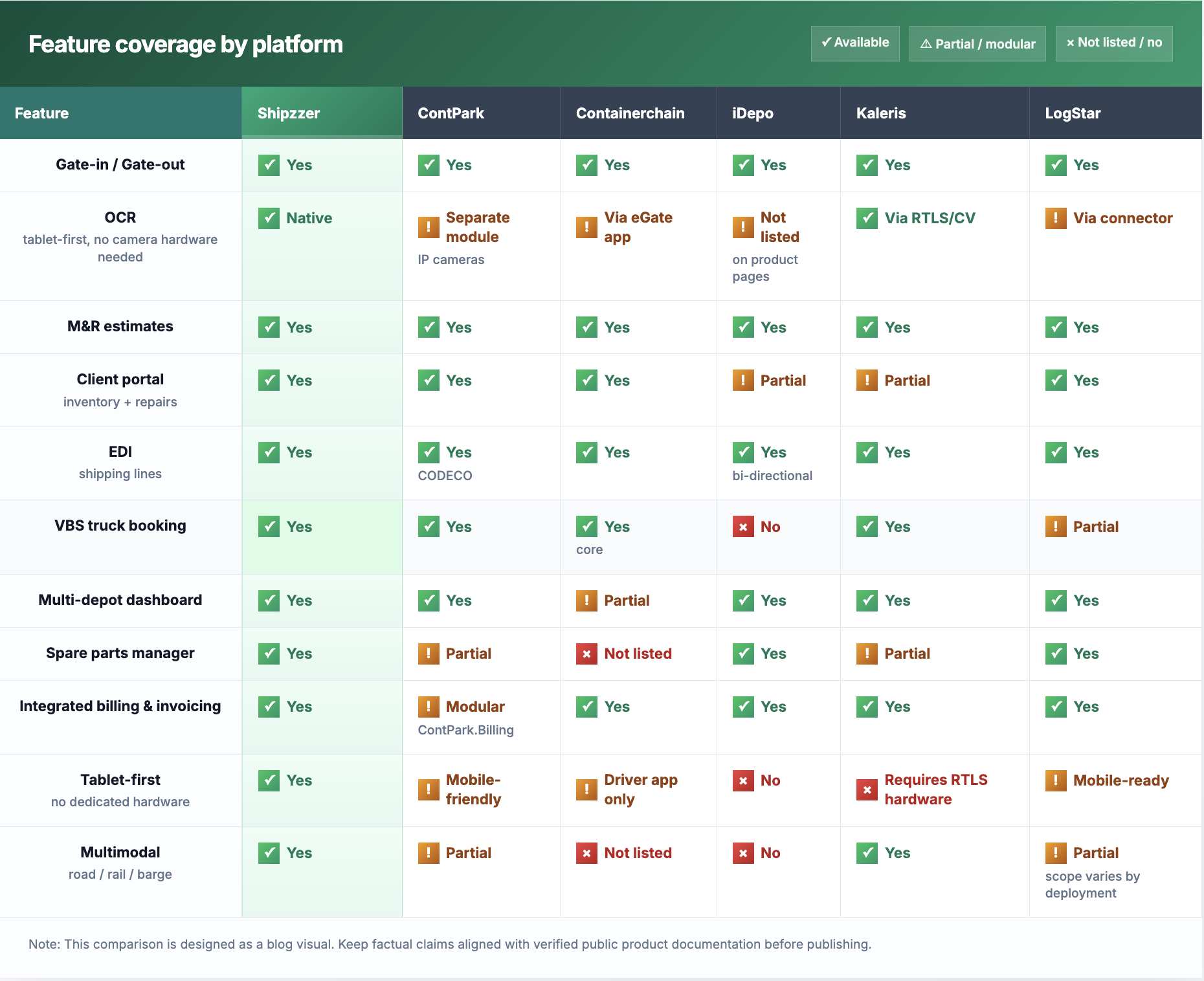
✅ Confirmed from public product pages ⚠ Available but limited or via add-on ❌ Not listed as a native feature — sources verified April 2026
Want to see how Shipzzer manages container depots in real time? 👉 Book a Demo — tablet OCR, EMR quotes, multi-depot dashboard. No slides, just the real workflow.
5- How to choose the best yard management software for your depot
The right yard management solution depends less on feature count and more on one question: does this platform understand how your specific depot operation actually works?
The honest test to run with any vendor: ‘Show me exactly how a container comes in, gets surveyed, gets a repair quote generated, and gets that quote approved by the shipping line — in your system, on a tablet, today.’ The answer tells you everything.
Choose Shipzzer if you run a small or medium inland multimodal container depot, your team works with tablets on the yard floor, and you need container storage, OCR, EMR quotes, shipping line approval, multimodal tracking, full workflow automation, rich functionality, EDI automation, and real-time multi-depot view in one uninterrupted workflow.
ContPark is the right fit if you manage an inland depot or ICD with significant volume and need modular cloud coverage with strong yard visualisation, CFS capability, and broad EDI.
For depots where gate congestion and truck turnaround time are the primary challenge, Containerchain stands out — its VBS and eGate automation are among the strongest for high-throughput operations.
iDepo suits operators running a dry container depot who want a proven web-based system covering the full depot lifecycle, used across Asia-Pacific, Africa, and Europe.
Enterprise-scale operators with dedicated IT resources will find Kaleris a strong match, particularly when RTLS precision, deep TMS/WMS integration, and Gartner-recognised analytics are priorities.
LogStar is ideal if you manage a mid-to-large inland depot, dry port, or ICD with complex multimodal operations (road + rail + barge) and need ERP integration alongside depot management.”
👉 Not sure which fits your depot? Schedule a call with Shipzzer — we will tell you honestly if we are the right fit or not.
6-Yard management software vs terminal operating system (TOS) — what is the difference?
This is one of the most common sources of confusion when depot operators start evaluating software. They are not the same thing, and choosing the wrong category is an expensive mistake.
A Terminal Operating System (TOS) is designed for large port terminals — berth scheduling, vessel planning, crane allocation, and stevedoring operations at scale. Systems like Navis N4 handle thousands of container moves per day across a port. They require significant IT infrastructure, dedicated teams, and enterprise budgets.
Yard management software for container depots focuses on what happens inside an inland depot — gate in/out, damage inspection via tablet, EMR repair quotes, shipping line EDI approval, yard inventory, spare parts tracking, and billing. It is built for the depot team working on the yard floor, not for port crane operators and berth planners.
The practical test: if your operation involves vessel scheduling, berth windows, or stevedoring — you need a TOS. If it involves container intake, damage surveys, EMR quotes, and storage at an inland depot — you need depot yard management software.
Shipzzer is not a TOS. It is built exclusively for inland container depot operations — from gate in to EMR quote to invoice — used by the yard team on standard tablets.
7-FAQ
What is the difference between a yard management system (YMS) and a terminal operating system (TOS)?
A terminal operating system (TOS) is designed for large port terminals handling thousands of container moves daily, with vessel scheduling, berth planning, and crane allocation as core features. A yard management system for container depots focuses on storage, gate moves, M&R repairs, and shipping line communication. Shipzzer is designed for depot-scale operations. For IICL container inspection standards relevant to depot surveys, see iicl.org.
Can yard management software work on a tablet without fixed camera hardware?
Yes — Shipzzer is built tablet-first. Your team scans container numbers like MAEU 123456 5 from the yard using OCR on a standard tablet, with no fixed cameras required. ContPark’s OCR (VisionAI) is a separate module that requires IP camera infrastructure. Containerchain’s eGate app is designed for truck drivers, not depot operators doing inspections. iDepo’s public product pages do not list a native OCR module. Learn more about the mobile yard management app.
What is EMR in container depot management?
EMR stands for Equipement Maintenance and Repair. It covers container damage detection, repair cost estimation, and shipping line approval. In Shipzzer, this runs from inspection to client-approved quote without phone calls or email chains. See how the EMR quotation feature works in detail.
Does LogStar support inland container depots?
Yes. LogStar specifically targets inland depots, ICDs, dry ports, and multi-modal hubs. Their product LogStar Depot Plus covers gate management, yard planning, M&R, billing, EDI, and multimodal operations. It is positioned for mid-to-large operations and requires an implementation project. Pricing is custom and quote-only.
Do any competitors charge per transaction rather than a flat subscription?
No public pricing was found confirming per-transaction fees for Containerchain.
Their terms of use reference transaction processes and billing details, but explicit per-transaction pricing for depot operators was not confirmed from a current official pricing page. All competitors on this list operate on custom quote pricing. Shipzzer uses a subscription model with predictable monthly fees.
Is yard management software suitable for a small container depot?
Yes — if you choose the right one. Enterprise platforms like Kaleris and LogStar are built for large-scale operations and will be overbuilt and over-budget for most SME depots. Shipzzer and iDepo are the most SME-appropriate tools on this list. Shipzzer specifically targets depots handling 20 to 400 containers per day with a fast deployment model and no heavy IT requirement.
8-Final verdict
The best yard management software for a container depot in 2026 is the one that matches your actual operation — not the one with the longest feature list or the biggest brand name.
If you manage a small or medium container depot, your real question is: which tool will your yard team actually use, which one handles EMR quotes without creating extra work, and which one connects directly to the shipping lines you work with — from a tablet, today.
Shipzzer was built to answer all three — with tablet-first OCR, automated gate, yard and EMR workflow, EDI-compliant shipping line approval, multimodal depot tracking, and a live multi-depot dashboard your whole operation can run from day one.
👉 Ready to see it on your depot? Book a free demo with Shipzzer — no slides, just the real workflow.
Leave a Reply